
A Family’s Geography
It is my second trip. I make the 90 minute drive north from Little Rock to Batesville. I am not nervous, simply aware that I am being moved by a bigger force than myself. This place, Kay’s home, is tucked between the hugging hills of sand and rock at the base of the Ozarks.
Over the next three days I will proceed to absorb fifty years, piecing together fragments from my first visit in October and this Christmas visit. I cannot say that I resemble either the Buchanans or the Lovells, her family, although everyone sees in my eyes and in my gestures elements of Kay. She desperately wants me to know of them; Uncle Paul, the newspaper man, and all such uncles who formed a strong and reputable line in service to our country through the military. I listen, but do not feel compelled to learn of their service, their businesses, and their political connections. Is this deflection of my birth mother’s heritage from too many years of encouraging myself to become a Flaherty? No, what does compel me is to learn of their high functioning alcoholism and escapade, passed to Kay and then me.
Adoption can do this, can require you to find a way to become other. Since there is a great absence of information about ones past, ones roots, you give yourself permission to make up what you need. The question of “Who Am I ?” had - until now - always been impossible to answer. I could act out of ignorance and avoid the consequences of knowing.
Imagine, then, at almost 50, a stranger approaching you to fill in the blanks, like a river spilling its banks with the threat of flooding. While Kay reaches out as a decades-absent mother, I approach her not as her son but as a grown man, raised lovingly by others. I am aware enough to know that I must not turn into a child under her touch; her pain and suffering might suffocate this innocent boy. But as a man, I am able to share and ease her pain. So, I came to Arkansas as a grown man, a recovering man, and ready to absorb her story.
We all come from somewhere, born from someone; a person, a place shaped by circumstance. Identity is not a perfect art, but a malleable sentience. So I begin the re-crafting of my life; merging two lives, two mothers, and two families into the singularity of Andy.
On Tuesday, December 28th we drove to Memphis. As we left the foothills and crossed the flatlands of the delta, I felt the hum of the car and sensed the constant migration of birds. Green-winged teal and mallard ducks danced with tree swallows and laced the vast horizon. There were fields of brown and gold in all directions and a hint of light on an otherwise gray day. We were traveling to see sister Norma and her husband Robert, the only family Kay has left. When we arrived in Memphis we enjoyed a visit to the Peabody Hotel, delighted in barbecue at the Rendezvous, and then spent the night in Norma’s lovely home.
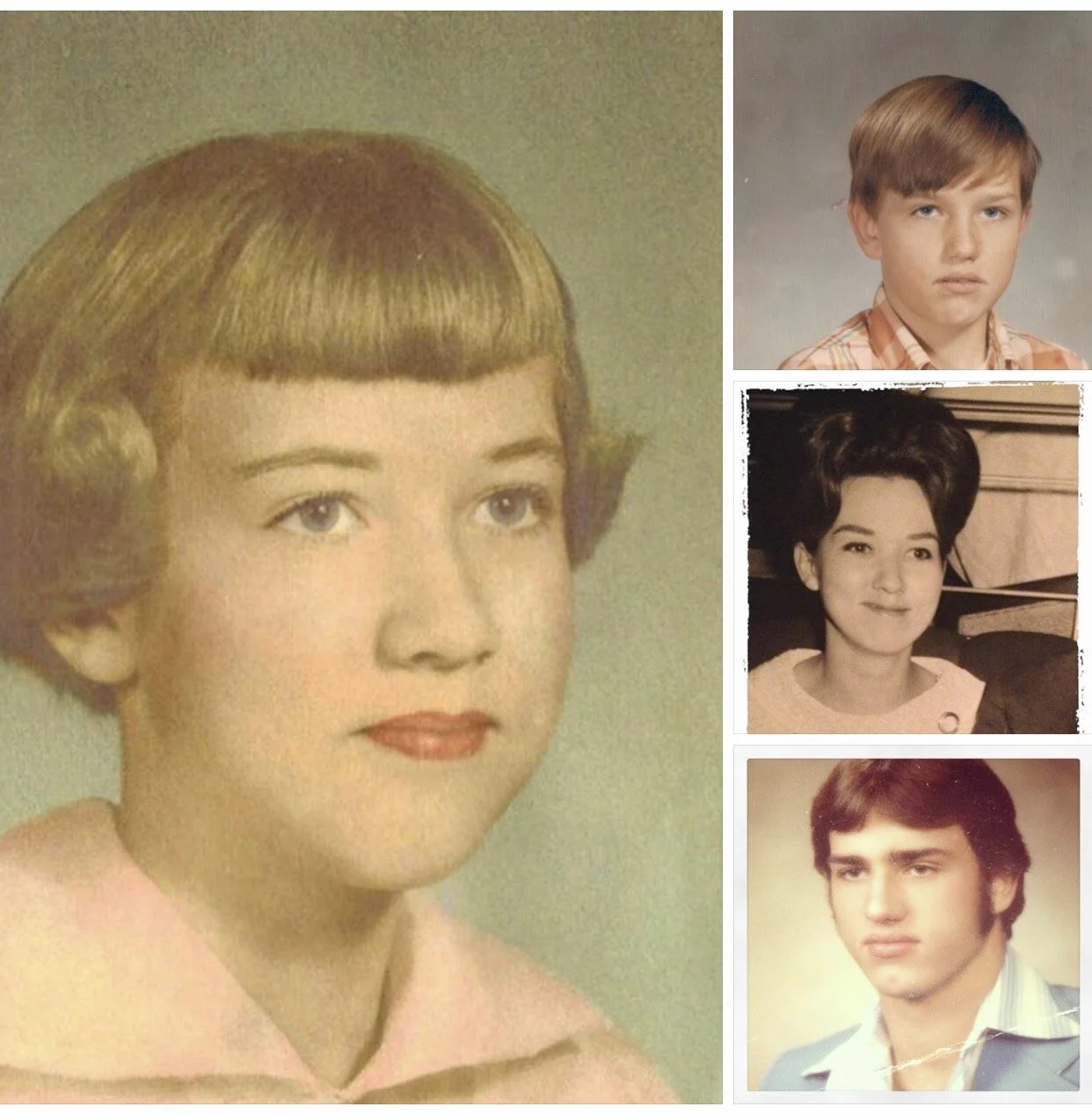
All other family have passed in the last few years. Kay’s beloved Aunt Clara Buchanan was gone. Kay’s mother and father have died too, as well as numerous aunts and uncles on both sides, Lovells and Buchanans. Aunt Clara was Kay’s angel. She invited Kay to work with her for Senator Fulbright and the Senate Foreign Relations committee in Washington, DC. When Aunt Clara died, she left everything she had to Kay. I can only assume it was because Clara knew and appreciated all of Kay’s struggles. This loss, combined with Kay’s cancer, must have seemed insurmountable at times. I know the toll Kay’s addiction took on the family. Like the rings on rock after high water, memory’s traces are inconsistent and imprecise records. I am sure her pain and frustration must have taken center stage, just as they have in my own life. During this visit, Norma gave me a single picture as a memento, that of my grandfather, Curtis Lovell, at age 19. I have decided I possess his eyes, eyebrows, lips, and the golden skin of the Lovells. Staring at this generational specter, one wonders what other hidden traits will surface.
Wednesday, December 29th, we drove from Memphis back to Batesville in the pouring rain. The flatlands heading west filled with the runoff. Red-tailed hawks wintering in the delta perched majestically along the way. This drive became my “Trip to Bountiful.” I continue to learn: Kay feels she is alone. She is in many ways the last of the line. She liked to sing and wished she could have been a dancer. She loved art and tried, fairly well I learned later, to paint. Every once and awhile she sang a song such as the one her mother sang to her to push her toward sleep years earlier, a song about a soldier going off to war. Abruptly, she switched to another from “Stop The World I Want to Get Off,” but this one in Russian with repeated lyrics intoning, “little boy, little boy.” Her choice of song was telling, as we moved along this road again, a route she must have driven many, many times with her own mother. What was familiar to Kay was surreal to me, and our stories, our songs, our struggles warp and weave, then and all these years after.
Although the details I heard in our conversations could be the themes and motifs common to most families, one truth stood as tall as a single pine on the rocky Arkansas hillside: Kay Lovell was the only person in this enormous family to get sober and stay sober. This huge accomplishment, in a family limned with alcohol addiction, was underappreciated. In addition, she survived cancer and cancer complications - a broken femur, a replaced hip, and the many side effects of innumerable medications. Tendencies toward addiction and alcoholism weren’t the only genetic gifts she received.
But it was when we attended an AA meeting together that I saw her true legacy. “Miss Kay, we are so glad to see you and meet your son Andy,” were words I could comprehend. Here we finally made sense, we fit; the clarity released the dam of my emotions. This simple acknowledgement pointed to a woman who helped many alcoholics and addicts. Here was a woman who overcame her genetic disposition and continued to fight for sanity. While her biological family had disintegrated and disappointed her, her recovery family sustained her, and she them.
I identified with this woman. I saw myself in her unwritten history. We sat together and listened to our disease: the alcoholic thinking, the obsessions, the anxiety and panic attacks, the fear of abandonment, the distain for authority but the need for approval, and the bottomless pit of self-pity we fell into before we got sober. In those minutes there was not a single shred of shame. Just acceptance.
Despite lives of solitude and alienation, we found ourselves sitting together in a ragged building saying the Serenity Prayer. “God grant me the serenity to accept the things I cannot change“ has provided a path out of the insanity of our genetic inheritance. Our meeting in Batesville had been rehearsed for years each time we met another alcoholic, looking for the truth in their existence. When her silver bracelet clinked in search of my hand, she confirmed that I was always her son, a kindred spirit, on a parallel journey.
As I waited for my plane, I wondered if I had answered her question, “Andy are you comfortable with me?” I made a note to tell her again: yes. How odd that a process I began almost 20 years ago would provide the catalyst I needed then - our common recovery, more than our common blood, sustained me. The question of why I thought and felt so different my entire life was answered. Acceptance leads to forgiveness. My recovery, Miss Kay’s recovery, led us to this place, a place absent of geography but full of grace.
I remember reading about alchemy when I was young - how lead turns to gold, how failure turns to success, how insanity becomes sanity, how darkness turns to light. Is this not grace? On our first visit Ms. Kay said, “I need some light.” At first I felt sadness. How strange this alchemy thing is, thought, that her darkness brought me light. Wonderfully, miraculously, inconceivably, sadness turned to joy as I witnessed courage, felt strength, and found understanding. I have learned that when I am in the last chapter of life, despite complications, set backs, and struggle, I will continue to experience change and inspire others to change. After all, I am my mother’s son.
Miss Kay died four months later in May of 2010.